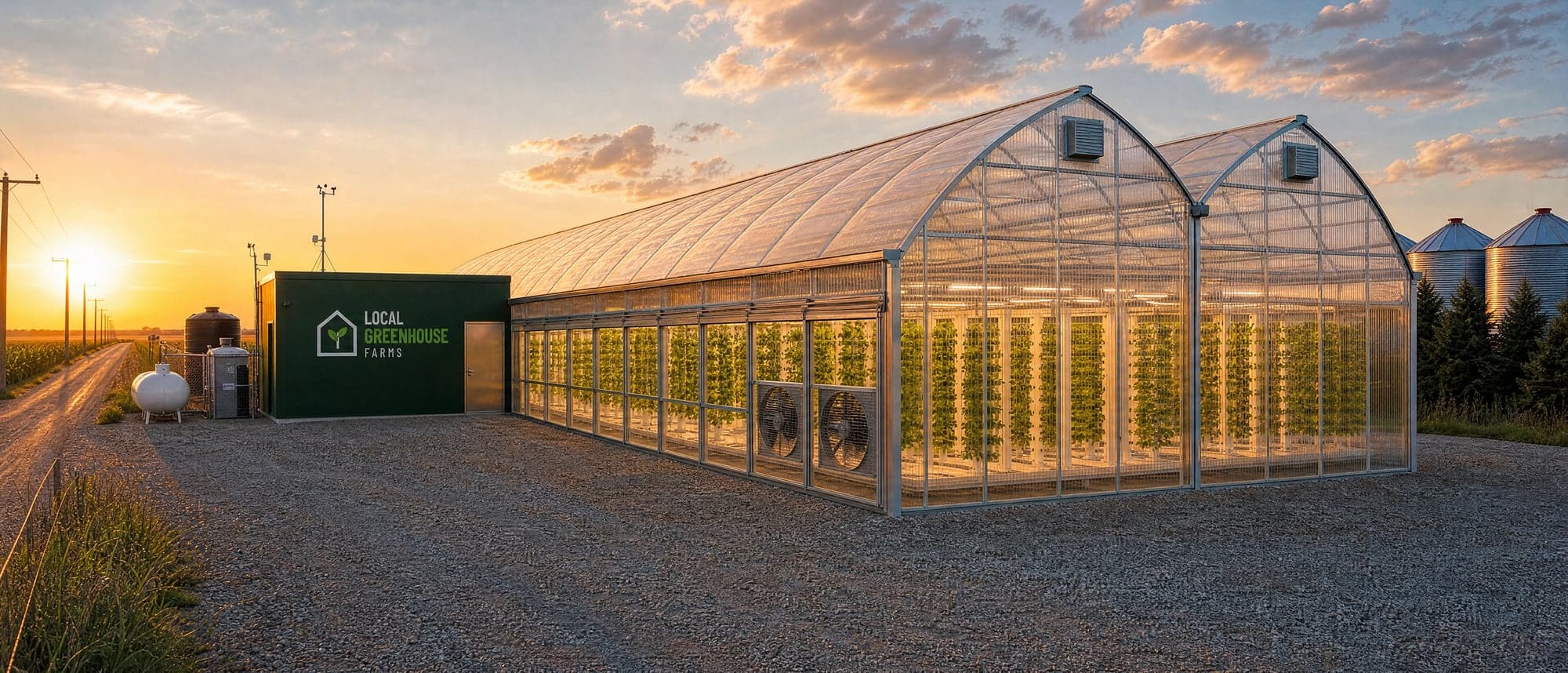
Greens in January. Grown on your ground.
A 2,700 sf climate-controlled greenhouse that harvests every week of the year. Lettuce, microgreens, and herbs for the schools and buyers in your county. Farmer-owned, franchise-backed.
Or see how it gets paid forFour things you can do in the next ten minutes.
Two minutes, no email. See what a year-round house grows at your prices.
GoNebraska is open now. Claim a 50-mile radius before your neighbor does.
GoFood safety, earnings, winter growing, and school buyers, written for farmers.
GoGrants and guarantees, with a specialist who works them with you.
GoCold-state schools want local produce. Their states grow almost none in winter.
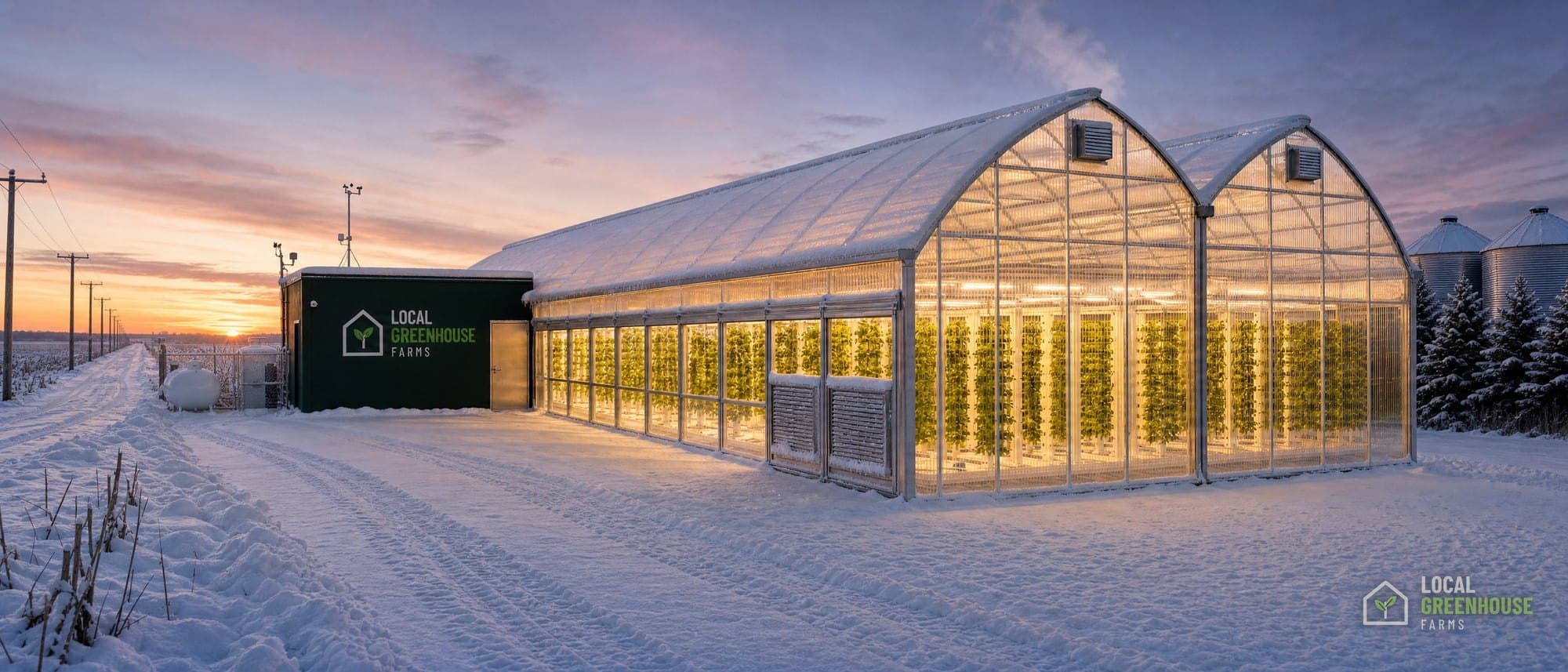
From the Midwest to the Northwest, a row crop farm earns from May to September. The rest of the year the income stops, the cash flow swings, and the produce a cafeteria serves in February comes from Arizona or Mexico, 1,500 miles and a week away.
Schools have said what they want: steady weekly volumes, pre-cut greens that fit cafeteria labor, and a local supplier who can deliver in January, not just in July. The demand is documented. What is missing is a farm within driving distance that can grow when the buying happens.
A field grower keeps about 25¢ of every vegetable dollar. Grow, pack, and sell from your own house and the whole dollar runs through your farm.
USDA measures what the farm receives out of each dollar a shopper spends on fresh vegetables. The other 75¢ pays the packer, the shipper, the distributor, and the retailer. When the growing, packing, and sale happen in your county, that 75¢ is yours to earn instead of theirs.
- 25¢ paid to you at the farm gate
- 75¢ to the packer, shipper, distributor, and retailer
- 25¢ farm value, same as before
- 75¢ more per dollar, earned by your house and your name, before operating costs
Source: USDA Economic Research Service, Price Spreads from Farm to Consumer, farm share of the retail value of a fresh vegetable basket (ERS price spreads, 2010 to latest; 20 to 29%, midpoint shown). The 75¢ is gross margin: a greenhouse owner pays labor, heating and lighting, packaging, and financing out of it, so net capture is lower and depends on the operation. Illustrative, not a performance claim; see Item 19 of the FDD.
The Opportunity
A climate-controlled greenhouse flips the calendar. It harvests in the weeks schools are buying, on a tenth of the water an open field uses, and it turns a four-month income into a twelve-month one.
Where the greenhouse fits.
Today the lettuce a school in the Midwest or Northwest serves crosses three states and changes hands four times. With a greenhouse in the county, the farmer owns every link from the seed to the cafeteria.
- 01 Seed
Seed and transplants
Varieties chosen for the crop plan, delivered as seed or started plugs from the program's price book, so every house grows what the buyers ordered.
- 02 Local Greenhouse Farms
Growing, every week of the year
Hydroponic towers under LED light in a climate the computer holds steady. Leafy greens, microgreens, and herbs on a weekly cycle, on your own ground.
Own outright: you run itFranchise: you run it, we back it - 03 Harvest & pack
Cut, wash, pack, and label on site
Harvested the morning it ships, packed to the school's spec, labeled with your farm's name and a lot code that traces back to the bay.
Own outright: on youFranchise: in the Local Greenhouse Farms chain - 04 Cold chain
Into the walk-in, not onto a truck
Chilled within the hour and held at temperature, with the log the food-safety audit asks for kept automatically.
Own outright: on youFranchise: in the Local Greenhouse Farms chain - 05 Local delivery
Miles, not states
Finished product moves to the schools, grocers, and restaurants in your county on a route measured in minutes.
Own outright: on youFranchise: in the Local Greenhouse Farms chain - 06 The cafeteria
Schools, grocers, restaurants, markets
School food authorities, independent grocers, restaurants, and NFN Farmers Market shoppers who want produce with a farm's name on it.
Own outright: on youFranchise: in the Local Greenhouse Farms chain
Green links are the ones a Local Greenhouse Farms owner controls. Buy a greenhouse outright and links three through six are your job. Franchise, and they are already built: the pack standard and labels, the cold-chain log, delivery service at rate, and placement with school and commercial buyers and NFN Farmers Market.
One chain, farmer-owned at every link.
Local Greenhouse Farms is the second link. Farmers and ground come in from Legacy Exchange, the greenhouse grows and packs on site, the program supplies the inputs and runs the delivery routes, and NFN Farmers Market and the school buyers put the produce on the tray. Every link is built and run by the same farmer network.
- 01
Legacy Exchange
Farmers and landThe producer network and land marketplace where farms, ground, and the next generation find each other. This is where the sites and the owners come from.
- 02You are here
Local Greenhouse Farms
Growing year-round on your groundThe climate-controlled greenhouse on the farmer's own site. Seed to harvest to pack under the farmer's own name, with the record following every lot.
localgreenhouse.farm02The same chain, for beefMeat Pod
Harvest and aging on your groundA USDA-inspected modular processing plant on the producer's own site, run by the same farmer network. One chain, two ways to own the middle of it.
meatpods.com - 03
Program Supply and Delivery
Inputs in, produce outSeed, transplants, nutrients, and packaging from one price book, and a delivery service that runs the school and grocer routes so the grower can stay in the house.
Run by the franchisor for franchisees - 04
NFN Farmers Market
The shelf, and the cafeteriasProducer-owned retail that puts your greens in front of shoppers under your name, plus the school food authorities, grocers, and restaurants the program connects you with.
Buy a greenhouse outright and links three and four are yours to arrange. Franchise a territory and they are already built.
Buy a greenhouse, or plug into the whole chain.
Both paths put a climate-controlled greenhouse on your ground. The difference is everything around it. Buy one outright and the house is yours, and so is every job between the seed order and the school's loading dock. Franchise, and the house drops into a supply and sales chain that already exists, with the crop plan, the buyers, and the paperwork worked out.
| What it takes | Buy a greenhouse | Franchise a territory |
|---|---|---|
| The greenhouse itself | You spec it and buy it from a builder | Turnkey 2,700 sf house to the Local Greenhouse Farms standard, delivered and commissioned |
| Growing, every week of the yearSupply chain link | You run it | You run it, on the Local Greenhouse Farms crop plan |
| Seed, transplants, nutrients, packagingSupply chain link | You source it | One price book, program-branded, delivered on schedule |
| Wash, pack, label, and cold chainSupply chain link | Your own setup and your own paperwork | Pack standard, labels, lot codes, and the cold-chain log on the platform |
| Delivery to schools and storesSupply chain link | You drive it | Delivery service to your customers, at rate |
| Schools, grocers, restaurantsSupply chain link | You find the buyers | School and commercial prospect connections, plus NFN Farmers Market placement |
| Marketing and brandSupply chain link | You build it from zero | Hosted site with e-commerce, marketing materials, and the brand behind your farm's name |
| Farmer network and land access | Your own contacts | LandChain and Legacy Exchange member network |
| Operations software | You choose and license | Cloud operations management system included |
| Food safety (GAP) and compliance | You build and maintain it | Program templates, training, and compliance monitoring |
| Grant and SBA funding help | Yes, from our in-house team | Yes, from our in-house team |
| Protected territory | No | Yes |
| Owning the greenhouse and the ground it sits on | You | You |
| Day-to-day growing and harvest | You and your crew | You and your crew, with the help desk, best-practice library, and peer forum behind you |
| Site prep, permits, utilities | You, to our site standard | You, with Local Greenhouse Farms site selection and build-out support |
| Heating, lighting, and power bills | You | You, on an energy-efficiency spec with REAP grant help |
| Local buyer relationships | Yours to build | Yours, in your territory, with the program's leads behind them |
| Operating and working capital | You | You |
| Following the Local Greenhouse Farms system and brand standards | Not required; no system to follow | Required; it is what the chain runs on |
Buy a greenhouse when
You already have the buyers, the delivery route, and a grower on staff, and you want a house on your ground with no royalty and no system to follow.
Franchise when
You want to grow and let a chain that is already built handle the crop plan, the inputs, the pack standard, the school and grocer leads, the delivery routes, and the compliance.
See how each path gets paid forHow the Franchise Disclosure Document worksOne climate-controlled greenhouse. Five parts.
A steel-frame, polycarbonate house of roughly 2,700 square feet that holds temperature, humidity, light, and CO2 at growing conditions in any month. Delivered to your pad, connected, and commissioned, with the bays as the unit you add when your accounts grow.
Buy a house outright and you take all five parts. Franchise a territory and you take the same house on the Local Greenhouse Farms standard, with the crop plan, pack spec, and platform already loaded.
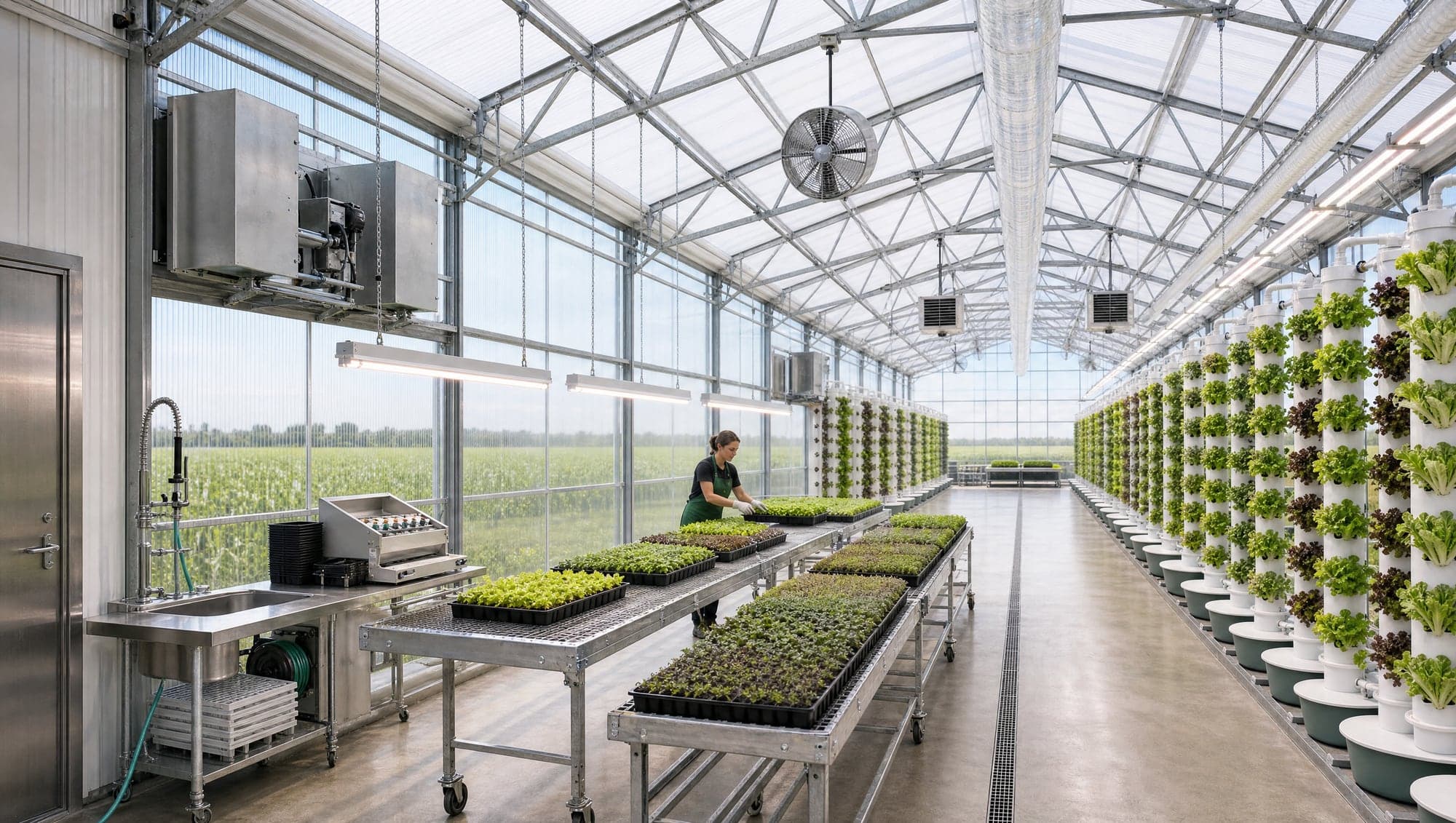
Concept rendering. Final equipment layout per manufacturer drawings.
Where every crop starts. Seed lots are sown into trays on a schedule the crop plan sets, germinated under their own lights, and moved to the towers as plugs, so a bay is never empty between harvests.
- Germination and seedling benches with dedicated LED
- Tray and plug system matched to the tower cups
- Sowing calendar driven by the buyer's weekly order
- Seed lot, variety, and sow date recorded to the platform
- Germination rate logged per lot, so weak seed is caught early
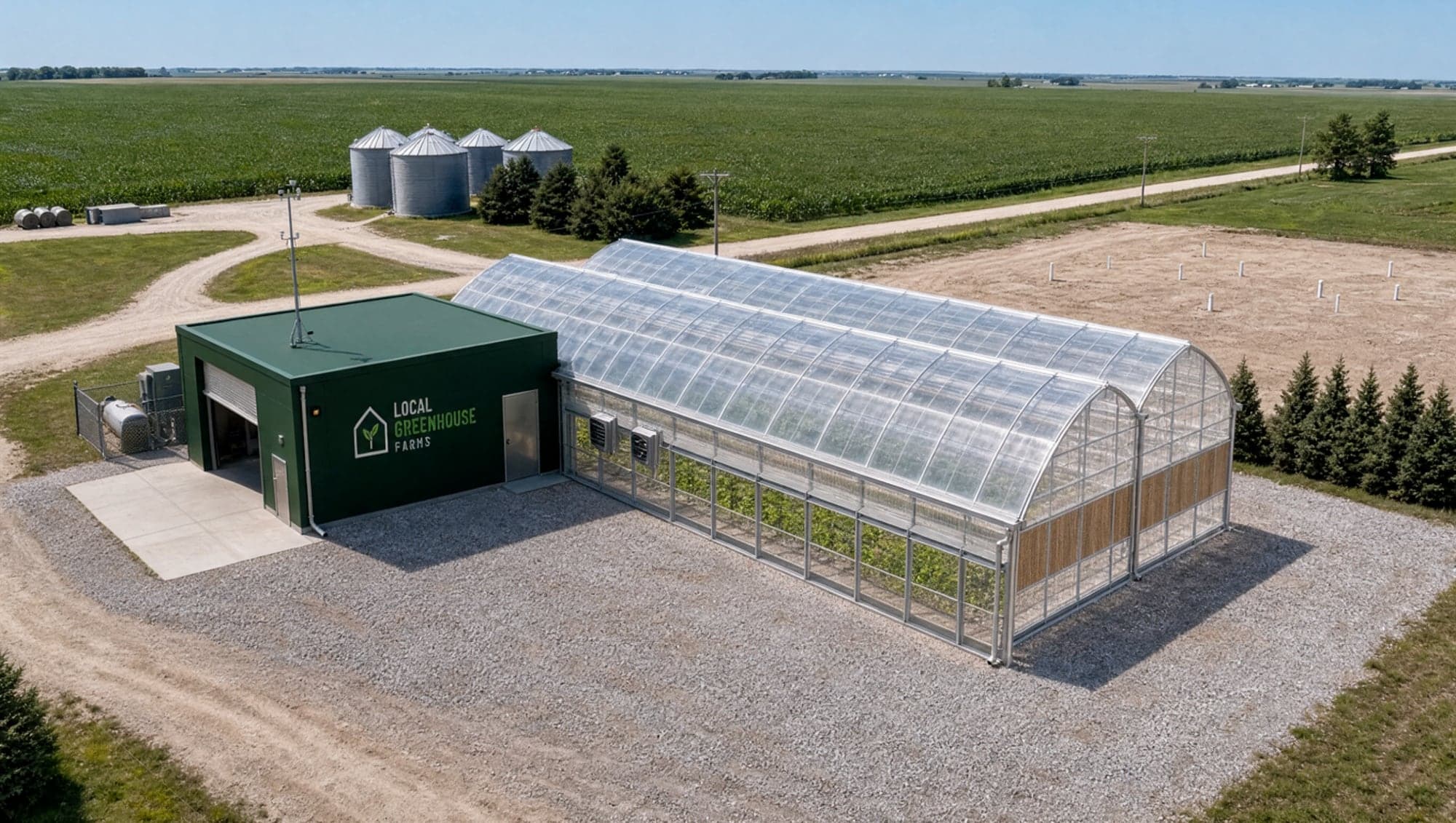
Every site built to the same standard.
Pad, foundation, and drainage
A level pad with a perimeter foundation and drainage that carries roof and wash water away from the house. Site prep, foundation, and utility hookups are priced separately from the structure, and they are what sets the timeline.
Three-phase power and standby
LED lighting, pumps, fans, and the climate computer run on a three-phase service with a standby generator, so a January outage does not become a lost crop.
Water and gas
A tested water supply for the recirculating nutrient loop and the wash line, and a gas service for the heaters. Evaporative cooling and thermal curtains keep both bills down.
Expansion-ready
The pad and the utilities are sized for the bays you will add, so growing with your accounts means bolting on the next section, not starting over.
Want one on your ground? Get on the list.
We open a limited number of territories each quarter, state by state, in the order farmers commit. Tell us where you are and what you want to grow, and we will call with a site timeline and the next steps. No cost, no commitment.
- Nebraska first. Enough growers in one area anchors delivery routes to more schools and stores
- Timeline is driven by site prep: pad, power, water, and gas
- Our in-house SBA specialist walks you through funding before you sign anything
A farm business in a box.
What the franchise fee buys. The greenhouse is the hardware; this is everything that makes it a business with customers on day one.
A Protected Territory
A territory around your greenhouse where no other Local Greenhouse Farms franchisee operates, sized so your school and grocer routes stay short, with right of first refusal on the territories next to yours as you grow.
Your Farm's Name on the Box
Your farm or family name is what the cafeteria manager and the shopper see and scan. Local Greenhouse Farms marks, packaging, and the hosted site certify the system behind it. We back your name, we do not replace it.
School and Commercial Buyers
Introductions to the school food authorities, grocers, restaurants, and institutions in your territory, plus placement at NFN Farmers Market. The program brings the leads; you bring the greens.
Crop Plan, Training, and Food Safety
A standardized production program: what to sow, when, and for whom. Training and onboarding for you and your crew, the food-safety templates a district asks for, and compliance monitoring so the audit and the harvest pass together.
Buying Power and Platform
Seed, transplants, nutrients, and packaging from one price book, and the platform behind the house: cloud operations software, a hosted site with e-commerce, a help desk, an industry news center, and a peer forum of other growers.
Financing Introductions
Pre-vetted lenders and programs for the build: SBA and USDA-guaranteed loans, FSA facility loans, energy grants, specialty crop grants, and your state's programs. Our in-house grant and SBA specialists walk you through.
See financing and grantsOne seed lot, one record, from the tray to the cafeteria.
Every bench in the house, every pack lot, every truck, and every box writes to the same record. The platform reads it back as food-safety compliance, yield by bay, and a story the buyer can scan. It ships only with the franchise, because it is the connective tissue of the whole Local Greenhouse Farms chain.
Seed lot received
- Variety, supplier, and seed lot number
- Germination rate on the lot
- Which buyer's order it was sown for
- Lot
- SL-26-0412
- Variety
- Butterhead, Rex
- Germ
- 96%
- For
- Seward Public Schools
Example data for illustration.
Food-safety paperwork writes itself
Seed lot to bay to harvest to pack lot, with the water tests, sanitation checks, and temperature logs attached. The record the auditor wants is the record the system already keeps.
Yield you can see, by bay
Pounds harvested per tower and per bay against target, every week. When a bay comes up short, you know which one and which crop cycle.
Recipe tied to the result
Nutrient batch, light schedule, and days to harvest follow the crop through to the weight and the quality. The plan learns what grows best in your house, and the next cycle is set to match.
Your name on every box
Your farm or family name is what the cafeteria manager and the shopper see and scan. The QR opens your farm, your county, the harvest date, and a link to your own site. Local Greenhouse Farms is the system behind the label, never the name in front of it.
Cold chain to the cafeteria door
Into the walk-in within the hour, scanned onto the truck, scanned off at the school, temperature logged in between. The district gets proof, not a promise.
Recall in seconds
Any box traces back to its pack lot, its bay, and its seed lot instantly. A recall is one lot from one morning, not a season.
Full system details are shared after the discovery call. Buy-outright owners can license third-party farm software; the Local Greenhouse Farms platform is reserved for franchisees.
Book the discovery callWhat runs through a greenhouse.
A house earns two ways: your own greens sold to schools, grocers, and restaurants in the months you used to have nothing to sell, and, under the franchise, placement through the Local Greenhouse Farms chain. How much that adds up to depends on your crop mix and your accounts, so instead of printing a projection we start from the per-square-foot figures below and run your numbers with you on the call.
of climate-controlled house, with multi-tier towers putting more canopy under the roof than the footprint suggests
12 lb for leafy and specialty greens, 13 lb for herbs, about 45 lb for microgreens on the program crop plan
$5 to $8 wholesale for leafy greens and herbs; $30 to $35 for microgreens, the highest-value line in the mix
wholesale to schools and grocers, and direct through NFN Farmers Market and your own accounts
Your crop mix, your square feet, the schools and stores within your delivery route, and your energy rate. One discovery call.
Farmers building for farmers.
Local Greenhouse Farms is a Nebraska Farmers Network venture, built by producers who know the land, the winters, and what it takes to keep income coming in from September to April.
Franchisor & Operating Entity
Nebraska Farmers Network
Member-driven ag platform spanning land, auction, financial services, and food infrastructure. Headquartered in Lincoln, Nebraska. NFN provides the crop plan, the compliance, the software, and the school and commercial demand that make a greenhouse work at scale, behind each farmer's own name.
Greenhouse Standard & Program
Local Greenhouse Farms
One repeatable house: a steel-frame, polycarbonate, climate-controlled greenhouse with hydroponic towers, full-spectrum LED lighting, CO2 enrichment, and a climate computer that ties the sensors and equipment together. Built by a national greenhouse manufacturer to a standard the whole network shares, so every site grows the same way.
Operating Leadership
Led by the guidance and experience of more than 500 farmers and ranchers of the Nebraska Farmers Network.
Producer-members who farm the ground, live with a four-month growing season, and watch the school down the road buy its lettuce from 1,500 miles away. Local Greenhouse Farms is built by them, for the farmer who wants twelve months of income from the same land, a name on the box in the local cafeteria, and a reason for the next generation to stay.
How owning outright compares to franchisingInformational only. Franchise opportunities are offered solely in jurisdictions where lawful and following delivery of the Franchise Disclosure Document and all required state filings. No earnings, revenue, or performance claims are made or implied. © 2026 Nebraska Farmers Network, LLC.
Ready to talk? Schedule a call.
Pick a date and time that works for you. Prefer to talk first? Contact the team.
Loading the scheduler…
By submitting, you agree to receive franchise information from Local Greenhouse Farms. No franchise fee is collected at this stage.
Frequently Asked Questions
What is the difference between buying a greenhouse and franchising a territory?+
Both put a climate-controlled greenhouse on your ground. Buy one outright and the house is yours with no royalty and no system to follow, but so is everything around it: the crop plan, sourcing inputs, the pack standard, food-safety paperwork, delivery, and finding the buyers. Franchise a territory and the house drops into the chain Local Greenhouse Farms already runs: the crop plan and training, price-book seed and supplies, the pack and cold-chain standard on the platform, delivery service at rate, and introductions to the school food authorities, grocers, and restaurants in your territory, plus NFN Farmers Market. You grow; the franchise handles the rest.
What does a greenhouse like this actually grow?+
Leafy greens, microgreens, specialty greens, and a culinary herb line, on hydroponic towers under LED light with the climate held steady by a computer. Those crops turn over in weeks, so a house harvests every week of the year, and they are what schools, grocers, and restaurants buy most consistently. Tomatoes, cucumbers, and strawberries are possible in the same house; the base crop plan starts with greens because that is where the year-round demand is.
How big is the greenhouse?+
The franchise unit is roughly 2,700 square feet of climate-controlled house, expandable as your accounts grow. Multi-tier hydroponic towers put more growing canopy under the roof than the footprint suggests, which is how a house that size feeds a county's schools. Our pilot house is being built now and is where the standard is being proven.
Why does year-round matter so much?+
From the Midwest to the Northwest, the outdoor season runs roughly May through September. Schools operate September through May. A farm that only grows in summer is closed for most of the months a cafeteria is buying. A climate-controlled house flips that: winter becomes a selling point, and a four-month income becomes a twelve-month one on the same land.
Do I lose my farm's name?+
No. The opposite. Your farm or family name is what goes on the box and what the cafeteria manager and shopper see when they scan it: your farm, your county, the harvest date, and a link back to your own site. Local Greenhouse Farms is the system behind the label: the house, the crop plan, the food-safety record, and the buyers. We back your name, we do not replace it.
What are the fees?+
The royalty is 5% of gross revenue, paid in perpetuity, and it covers training, the hosted site with e-commerce, the operations software, marketing materials, buyer connections, the help desk, and the peer forum. Consumables such as seed, transplants, nutrients, and packaging are bought from the program price book. The initial franchise fee and any installation fee are being finalized; we walk through the current numbers on the discovery call. The Franchise Disclosure Document in effect when you sign governs.
What does the greenhouse cost, and how is it paid for?+
Pricing for the 2,700 sf house is being finalized with our greenhouse manufacturer and is covered on the discovery call. What we can say now is how it usually gets paid for: equipment financing on the house and grow systems, FSA facility loans for cold storage and packing, SBA and USDA-guaranteed loans for the rest, and grants for energy, packing, and value-added produce stacked on top. Our in-house grant and SBA specialists do that work with you. Local Greenhouse Farms introduces lenders but does not finance the house directly.
Can I stack USDA grants on the financing?+
Yes, and that is the point of the stack. REAP covers up to half the cost of LED lighting, efficient heating, and solar. FSA Farm Storage Facility Loans cover cold storage and wash-and-pack at 15% down. Value-Added Producer Grants, the Specialty Crop Block Grant, and state food-system infrastructure grants cover packing, marketing, and school supply links. Our in-house specialists handle the applications alongside your financing paperwork.
What about the energy bill?+
Heating and lighting are the largest operating line in any greenhouse in a cold climate, and we do not hide that. The standard house is specified for efficiency from the start: full-spectrum LEDs that dim when the sun is strong, thermal curtains, gas heat with evaporative cooling, and a climate computer that runs it all together. The energy grants above exist to pay for exactly that equipment. Your numbers for your site are part of the discovery call.
Do I need greenhouse experience?+
No. The franchise is a standardized production program with training and onboarding for you and your crew, a best-practice library, a help desk, and a peer forum of other growers. What we do require: an owner who runs the house day to day, capital qualifications, and willingness to follow the system. If you buy a greenhouse outright instead, the crop plan and the crew are yours, and we provide training to get you started.
How long until the first harvest?+
Site prep runs alongside the greenhouse build, so the house goes up as the pad, power, water, and gas are ready. Greens are on a weekly cycle, so the first harvest follows commissioning within weeks, not months. We are targeting first franchise harvests in spring and summer 2027, and we will give you a timeline for your own site on the call.
Where can a greenhouse be?+
Nebraska to start, offered first to the 500-plus members of the Nebraska Farmers Network, with other states following as franchise registration completes. The house sits on your ground, so the produce moves miles to the school, not states. Distance to us does not matter; distance from your house to your buyers is what you are optimizing.
What decides how fast a greenhouse can be placed?+
Site pre-work. The pad, three-phase power, water, gas, and drainage have to be ready before the structure goes up. Farmers who start the funding intake and site planning early get placed first. Get on the list and we will give you a timeline for your site.
What is the territory?+
Each franchisee receives a protected territory around their greenhouse where no other Local Greenhouse Farms franchisee operates, sized so your delivery routes to schools and stores stay short. You also receive right of first refusal on adjacent territories as you grow. The exact boundary rule is set in the FDD and shown on the territory map.
Can I see financial projections?+
Any financial performance representation is made only in Item 19 of the Franchise Disclosure Document, which is provided after initial qualification, per FTC Franchise Rule requirements. The figures on this website are gross, illustrative program assumptions, not historical results and not a projection for your operation.