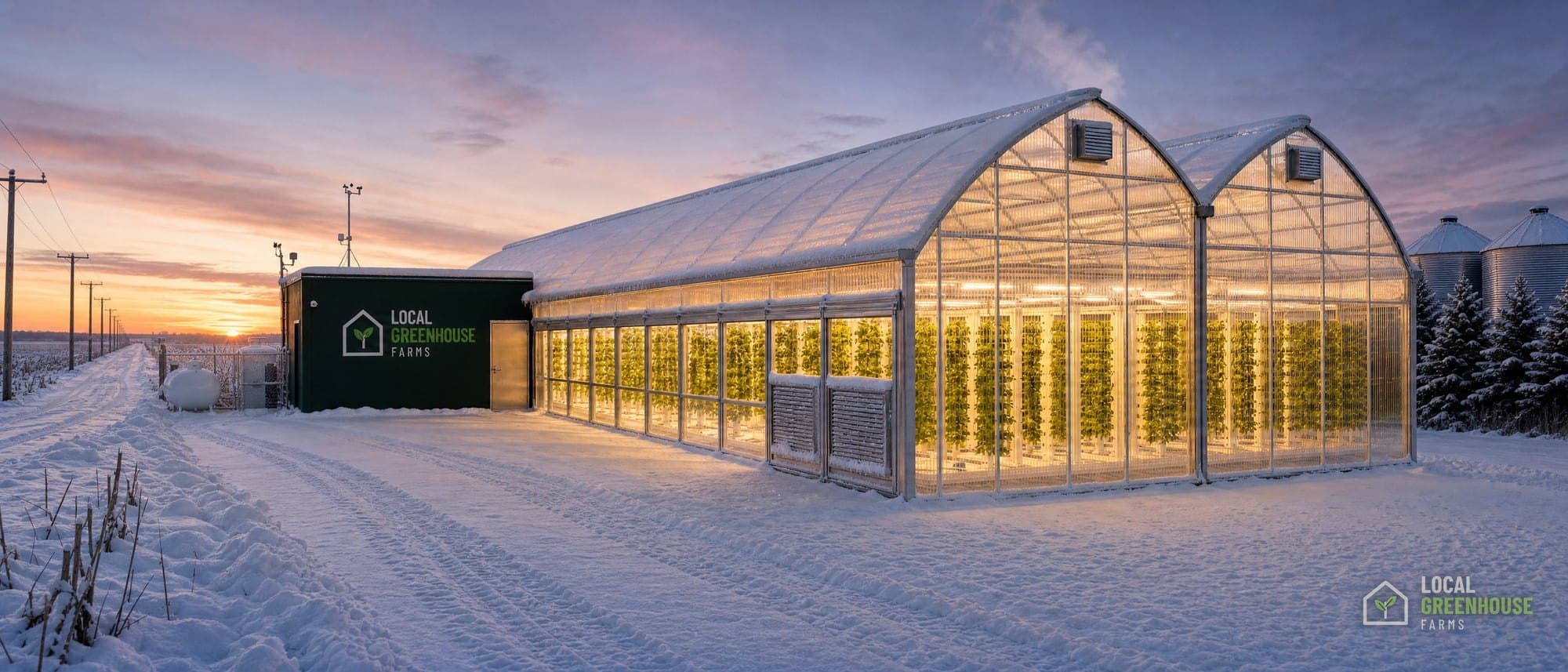
Every mile in between is a day of lost freshness.
The salad on a school tray in the northern half of the country has usually crossed half the country to get there. Local Greenhouse Farms replaces that entire chain with one greenhouse — in the county, run by a farmer with a name.
Seven stages. Five sets of hands. A salad that spends a week getting older.
Grown in a desert valley
The lettuce a cold-state cafeteria serves in February starts in California or Arizona, raised well by a farmer there — 1,500 miles from the tray it will land on.
Field harvest and field pack
Cut, boxed, and vacuum-cooled at the edge of the field. From this hour forward the crop only loses quality; nothing downstream adds any back.
The processing plant
Greens from dozens of farms meet in one wash line and one bag. The farm identity dissolves into a lot code that spans fields, counties, and sometimes states.
The 1,500-mile truck
Three to five days in a refrigerated trailer across the country. Every hour is fuel burned, quality lost, and one more chance for the cold chain to slip.
The distribution center
Pallets wait their turn, get broken down, and get reloaded. More days, more forklifts, more hands that never see the farm.
The distributor drop
A broadline truck delivers to the school or store alongside everything else. Nobody on the dock can say what field it came from or when it was cut.
The shelf, a week later
Often about a week old before the bag is opened, with a few days of life left. What wilts first gets thrown out — and a meaningful share of fresh produce never gets eaten at all.
One county. Hours, not weeks.
The greens are sown, grown, packed, and delivered from one greenhouse — by the farmer whose name is on the box.
Harvested the Morning It Ships
The order is cut, washed, packed, and in the walk-in before lunch, and on the cafeteria dock the same day. The freshness clock barely starts.
A Name on Every Box
The farm's name, the county, and the harvest date ride on the label. The buyer can scan it and see the bay it grew in. Trust is the product.
Recall Is One Lot, Not Five States
One house, one pack line, one lot code per morning. If anything is ever wrong, it is traced and contained in seconds, not spread across a region.
January Is a Selling Point
The house holds growing weather every week of the year, so the farm is harvesting in the exact months schools are buying and fields are frozen.
A Tenth of the Water
The recirculating tower system uses about 90% less water than soil growing, on land that keeps farming corn right up to the gravel apron.
The Dollar Stays Home
No packer, no cross-country freight, no distribution center. The county's food dollars go to a farm the buyers can drive past.
The conventional chain vs. the county greenhouse
Distance and transit figures are the standard USDA-cited averages for long-haul fresh produce; water and season figures are program planning assumptions. Illustrative, not a performance claim.
“Local means a name and a county, not a supply chain. The lettuce on the February tray was cut yesterday, eleven miles from the cafeteria, by a farmer the kids can wave at. A truck from 1,500 miles away can't deliver that.”
The Case for Growing Where the Eaters Are
One chain, farmer-owned at every link.
Local Greenhouse Farms is the second link. Farmers and ground come in from Legacy Exchange, the greenhouse grows and packs on site, the program supplies the inputs and runs the delivery routes, and NFN Farmers Market and the school buyers put the produce on the tray. Every link is built and run by the same farmer network.
- 01
Legacy Exchange
Farmers and landThe producer network and land marketplace where farms, ground, and the next generation find each other. This is where the sites and the owners come from.
- 02You are here
Local Greenhouse Farms
Growing year-round on your groundThe climate-controlled greenhouse on the farmer's own site. Seed to harvest to pack under the farmer's own name, with the record following every lot.
localgreenhouse.farm02The same chain, for beefMeat Pod
Harvest and aging on your groundA USDA-inspected modular processing plant on the producer's own site, run by the same farmer network. One chain, two ways to own the middle of it.
meatpods.com - 03
Program Supply and Delivery
Inputs in, produce outSeed, transplants, nutrients, and packaging from one price book, and a delivery service that runs the school and grocer routes so the grower can stay in the house.
Run by the franchisor for franchisees - 04
NFN Farmers Market
The shelf, and the cafeteriasProducer-owned retail that puts your greens in front of shoppers under your name, plus the school food authorities, grocers, and restaurants the program connects you with.
Buy a greenhouse outright and links three and four are yours to arrange. Franchise a territory and they are already built.
Grow where the eaters are.
See how a Local Greenhouse Farms house fits your ground — and what it means to feed your county fifty-two weeks a year under your own name.