Every Midwest farm has the same two seasons: the one where everyone has produce, and the one where no one does. The second season is eight months long, contains every week a school cafeteria is serving lunch, and is the reason winter growing is not a novelty but the single biggest open market in local food. This guide covers how greens actually get grown through a Midwest winter, from row covers to climate control, what each level costs in effort and energy, and why the growers who solve winter get the accounts everyone else pitches in July.
What winter actually takes away
Cold is the famous problem, but it is the smaller one. The bigger one is light. In late December the central Plains get about nine hours of daylight, and the low sun delivers roughly a third of June’s growing energy even on a clear day. Plants do not stop at freezing; they stop when there is not enough light to grow on. That is why the two halves of every winter-growing system are a way to hold warmth and a plan for light, and why systems that solve only the first produce survival, not harvests.
Winter also takes away margin for error. A July equipment failure costs a hot afternoon; a January one during a blizzard can cost the crop. Every serious winter operation in this region is built around that fact: engineered snow and wind loads, backup heat, and alarms.
The four levels of winter growing
Level one: season extension.Row covers and unheated high tunnels trap enough solar warmth to carry cold-hardy crops, spinach, kale, lettuce under cover, weeks past the first frost and start them weeks early in spring. Nebraska Extension has documented these methods for years, and USDA’s NRCS cost-shares high tunnels through EQIP. It is the cheapest rung and a real business improver. It is not winter production: harvests taper into December and the darkest weeks yield little.
Level two: the deep winter greenhouse.A passive-solar design proved out by the University of Minnesota: steep south-facing glazing, an insulated north wall, and thermal mass storing the day’s heat for the night. On almost no purchased energy it grows low-light greens through the darkest months. It is an elegant homestead and market-garden tool, and its ceiling is its virtue: production is modest, intermittent, and sized for a market table, not a distributor’s dock.
Level three: geothermal.Western Nebraska’s famous example, the Greenhouse in the Snow in Alliance, pipes air through the stable warmth of the ground and has grown citrus, figs, and grapes through Panhandle winters for a reported heating cost of about a dollar a day. It proves the point better than any brochure: with the right energy design, winter in Nebraska is a solvable engineering problem, not a season to surrender.
Level four: full climate control. Heat, supplemental LED, and automated ventilation hold the house in growing conditions every day of the year. This is the only level that produces the thing institutional buyers actually purchase: the same volume, the same quality, every week, including the second week of January. It carries the highest energy bill of the four, which is why it only makes sense paired with the crops and the buyers that pay for consistency, greens, herbs, and microgreens on weekly contracts, not commodity vegetables at summer prices.
Crops that love the dark months
Winter growing rewards the short and the leafy. Lettuce, spinach, arugula, kale, and Asian greens tolerate cool nights, grow on modest light, and turn over in four to six weeks. Spinach comes out of the cold sweeter than anything a summer field produces, cold concentrates its sugars, and chefs know it. Herbs run steadily all winter. Microgreens grow under LED on a one-to-three-week cycle and are effectively season-proof, which is why they anchor the high-value end of a winter crop plan. What does not belong in a farm-scale winter house: tomatoes, cucumbers, and peppers, which demand summer light and warmth that only industrial-scale glasshouses can buy profitably.
The earnings guide runs the revenue math on exactly this mix; the short version is that the winter-tolerant crops and the high-value crops are the same list.
The market that only exists in winter
Here is the part that makes winter the point instead of the obstacle. Roughly eight months of a year-round house’s harvest lands between September and April. In those months, school districts are in session and buying every single week, grocers’ “local” shelves sit empty, and restaurants pay their peak prices for fresh greens. The supply that could serve them is at its annual minimum. A grower who can deliver in February is frequently the only local bidder for contracts that run all school year, and food-safety paperwork, not price, is usually the gate. That gate has its own guide: GAP certification.
Summer growers compete with every garden in the county. Winter growers compete with a truck from Arizona, 1,500 miles away, carrying greens cut ten days ago. That is the whole business case in one sentence.
The revenue calculator shows what a year-round house grows at your prices, and how much of it lands in the months you used to sell nothing.
Open the calculatorWhat a house built for this looks like
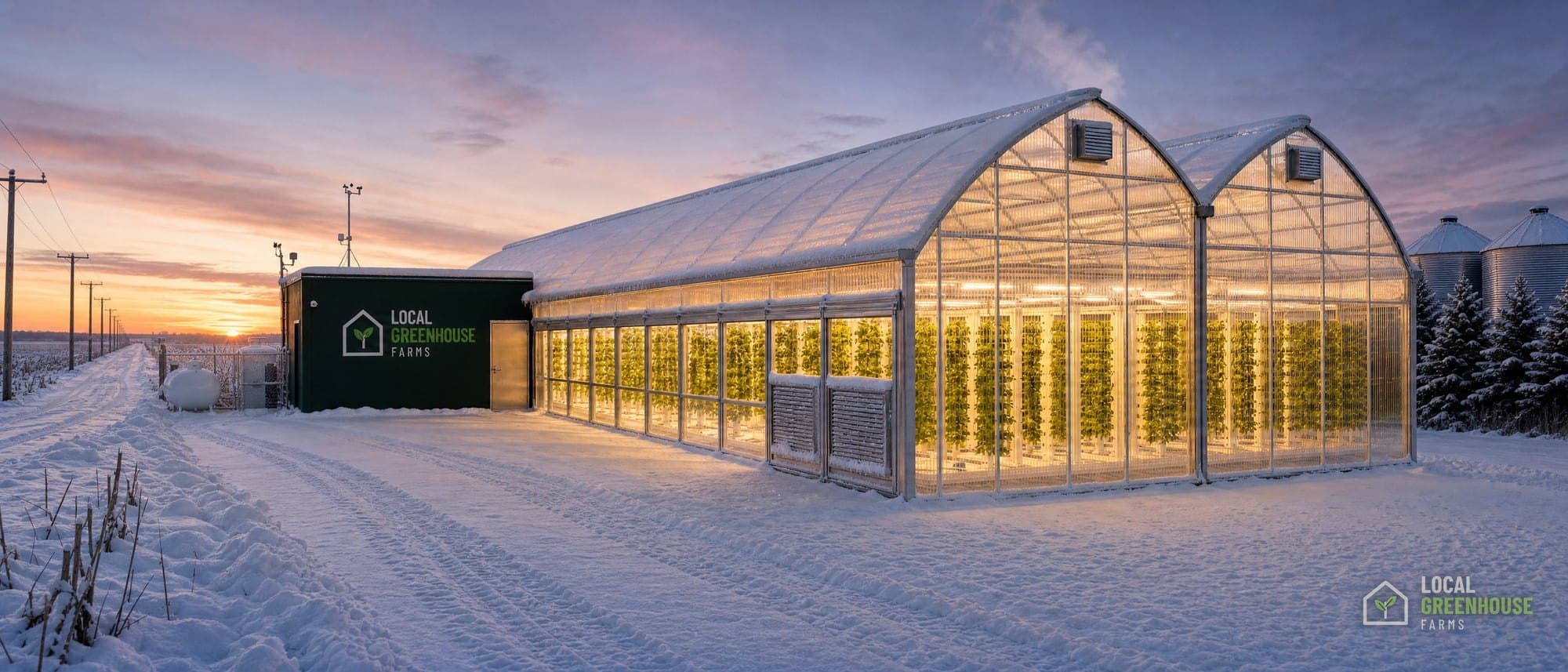
The Local Greenhouse Farms site standard is a level-four house designed for exactly this region: a gothic double-peak structure engineered for Plains snow and wind, double-layer glazing, unit heaters with airflow fans, supplemental LED over every tower, and automated controls with alarms, so the week of the blizzard and the week after it ship the same cases. The crop plan is the winter-proof mix above, and the buyers it is planned around, schools, grocers, and the delivery route between them, are the ones whose demand peaks when the snow is deepest. Winter is not the season the model survives. It is the season the model is for.
Questions growers ask
Can you really grow vegetables through a Nebraska winter?+
Yes, and Nebraskans have been proving it for decades: unheated high tunnels carry cold-hardy greens deep into winter, and heated or geothermal greenhouses grow year-round; one western Nebraska greenhouse has grown citrus through the winter for years. The question is not whether winter growing works but how much of winter you want to harvest through. A high tunnel takes you into December on hardy crops. A climate-controlled greenhouse takes you through all of it, every week, on a delivery schedule a school district can plan menus around.
Do you need grow lights in a winter greenhouse?+
It depends on the crop and how consistent the harvest needs to be. In December the Midwest gets about nine hours of weak daylight, roughly a third of the growing light of June. Cold-tolerant, low-light greens like spinach and Asian greens can crawl through on sunlight alone, which is how deep winter greenhouses work, but growth is slow and harvests are intermittent. An operation that has promised a school district the same case count every Tuesday runs supplemental LED so yields hold steady in the darkest eight weeks instead of dipping when the buyers need supply most.
What crops grow best in a winter greenhouse?+
Short, leafy, and cold-tolerant wins: lettuce, spinach, kale, arugula, Asian greens, herbs, and microgreens, which grow under lights on a one-to-three-week cycle and barely notice the season. Spinach actually improves in the cold, concentrating sugars that make winter spinach noticeably sweeter. Fruiting crops like tomatoes and cucumbers are the expensive choice: they demand summer light and warmth all winter, which is why winter tomatoes are the domain of huge industrial glasshouses, not farm-scale houses.
How much does it cost to heat a greenhouse through a Midwest winter?+
It swings too widely to give one honest number: it depends on the structure's insulation and glazing, the target temperature, the fuel, and the year's weather. What can be said honestly is the shape of the answer: heating is one of the two biggest operating costs of winter growing, greens need far less warmth than fruiting crops, and design choices, tight double-layer glazing, an insulated north wall, thermal mass, or geothermal exchange, change the bill by multiples. One well-known Nebraska geothermal greenhouse reports heating costs around a dollar a day. Get the energy design right before the first winter, because you pay for it every winter after.
Will a greenhouse collapse under snow?+
Not one engineered for it. Commercial gothic-arch houses are designed to regional snow and wind loads: the steep arch sheds snow rather than holding it, and a heated house melts what lands. The failures you read about are almost always unheated hobby structures or houses whose heat went out during a storm. In a place that sees blizzards, the structure's engineering stamp and a backup heat plan are not paperwork, they are the crop insurance.
Who buys local produce in the winter?+
The best customers of the year. School districts are in session and buying weekly from September to May, precisely the months fields produce nothing. Grocers advertise local all winter and can almost never stock it. Restaurants pay peak prices for February greens. A winter greenhouse is often the only local supplier bidding, which is a stronger market position than any summer Saturday at a farmers market shared with forty other growers.
Sources
- Nebraska Extension, Pushing the Season: Winter Vegetable Production
- University of Nebraska Omaha NBDC, Greenhouse in the Snow
- NPR, Citrus in the Snow: Geothermal Greenhouses Grow Local Produce in Winter
- University of Minnesota, Deep Winter Greenhouse Program
- USDA NRCS, High Tunnel System Initiative (EQIP)
- USDA Farm to School Program
Informational only. Regulations change and states differ; confirm with USDA, FDA, or your state department of agriculture before you act. Nothing here is legal advice, a franchise offer, or a financial performance representation.